

The BASEES annual conference was held from April 10 to 12, 2026, hosted this year by the University of Birmingham. The aim of this three-day international conference, featuring a rich program, was to provide a forum for the most significant current research examining the history and present of Central and Eastern Europe. Participating researchers, university students, and faculty members presented their projects and discussed the most important issues concerning the region’s past, present, and future within the framework of an interdisciplinary dialogue.
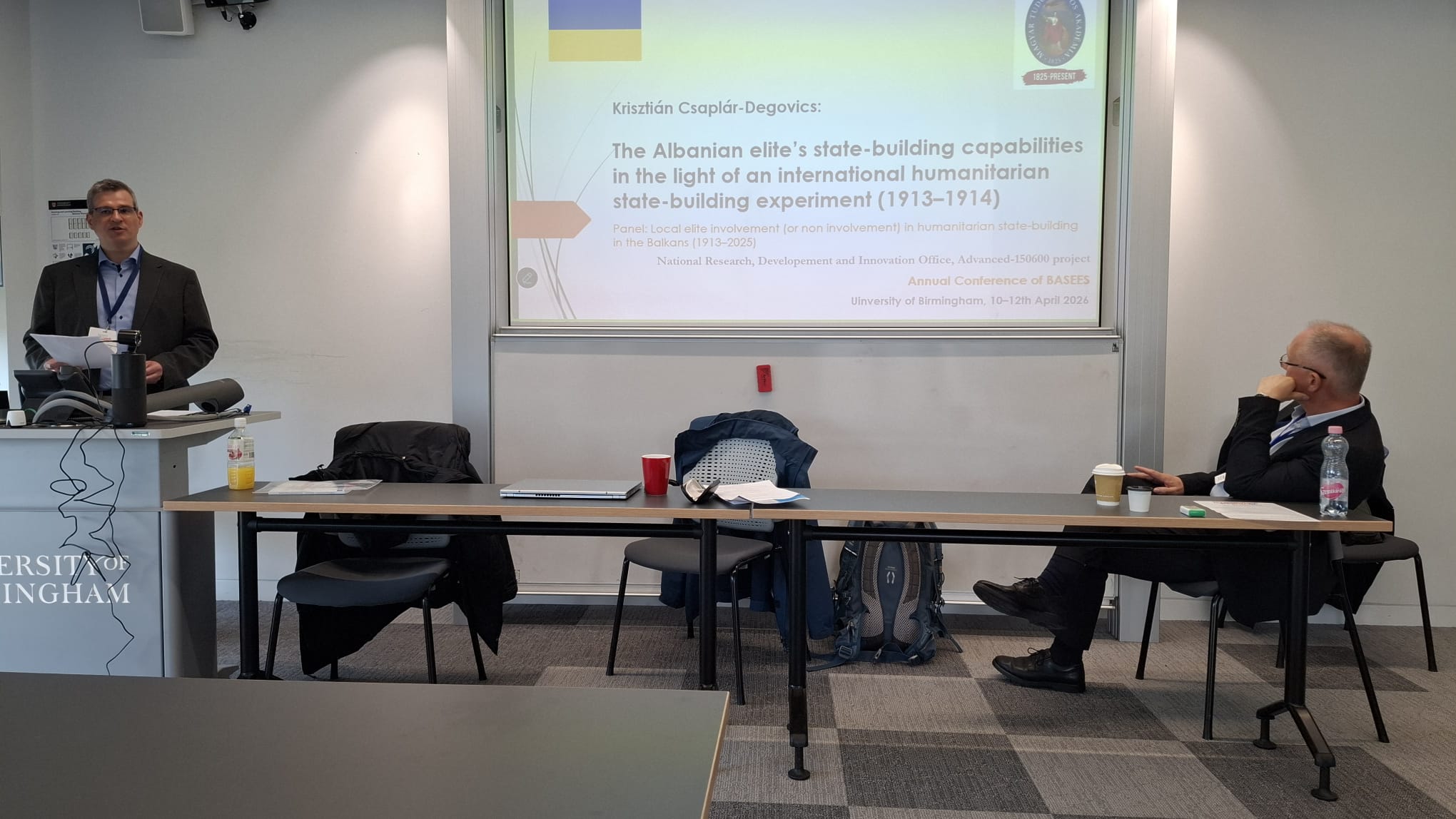
The panel titled “Local Elite Involvement (or Non-Involvement) in Humanitarian State-Building in the Balkans, 1913–2025” was organized and chaired by Krisztián Csaplár-Degovics. He also delivered a paper in the same panel titled “The Albanian Elite’s State-Building Capabilities in the Light of an International Humanitarian State-Building Experiment (1913–1914).” Also presenting in the panel were László Márkusz („The Serbian Political Elite and Humanitarian State-building in Kosovo and Bosnia”) and, representing the Berlin partner project, Kristóf Gosztonyi („Post-war state-building in Mostar: Local Knowledge and International–Local Elite Interactions”).
Historically South Eastern Europe has been a key region for international humanitarian interventions and internationally assisted state-building. The establishment of smaller sub-regional states followed the breakup of larger multi-ethnic states, the Ottoman Empire in the early 20th century or of Yugoslavia in the 1990s. Many of these successor states received active state-building assistance from what has been termed the international community. Such externally assisted state organization repeatedly took place in the Balkans: in Bosnia (1878 onwards), in Albania (1913–14, and again in 1997) and once again Bosnia and Herzegovina (since 1996) and Kosovo (since the 1999). State-building is always a challenging process, and attaining elite buy-in is often key to its success. This is particularly difficult when the intervention is externally driven and local knowledge and understanding by intervening international actors thus cannot be taken as a given. The literature on intervener understanding is thin in long-durée, region-wide comparisons.
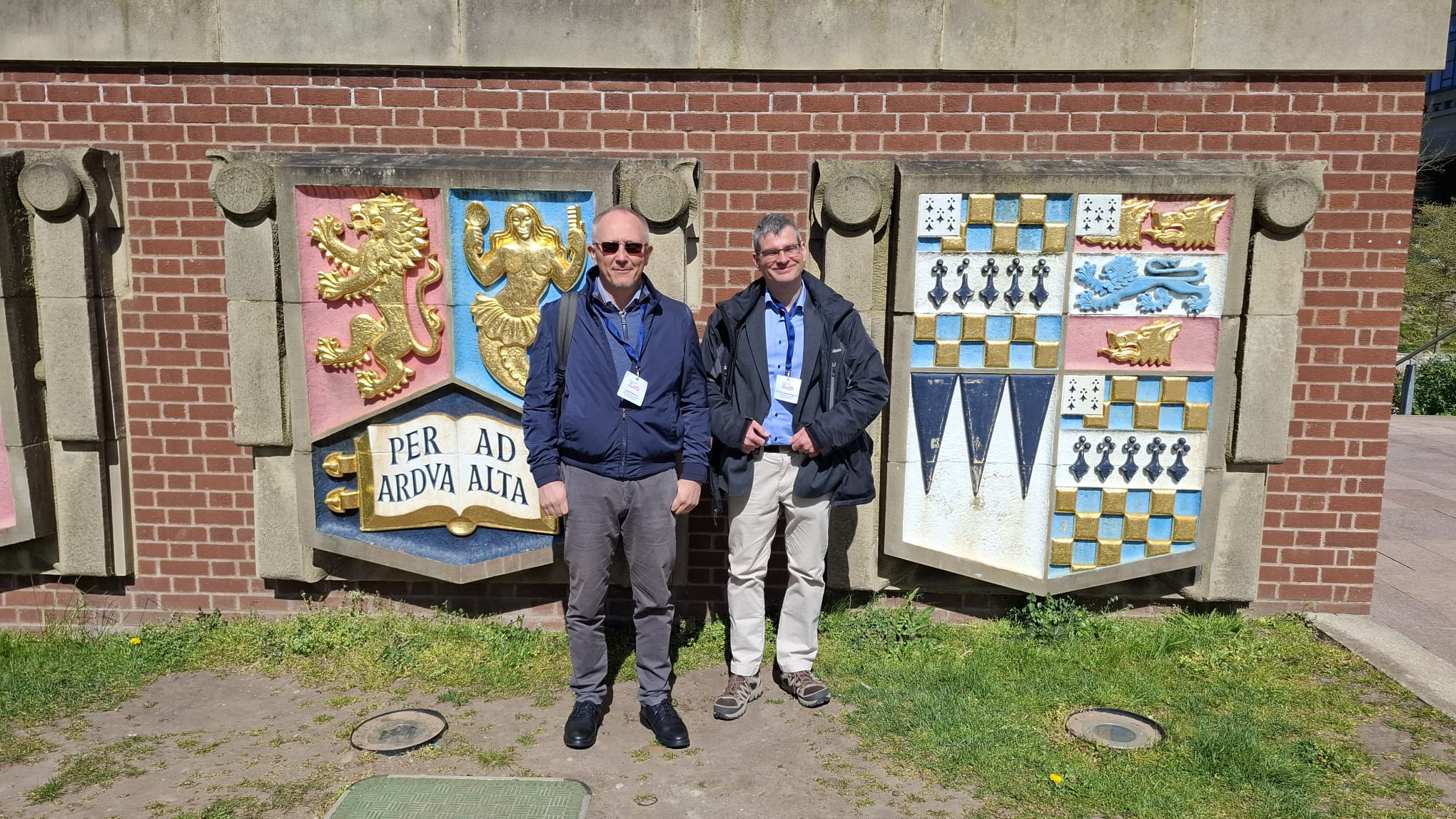 László Márkusz and Krisztián Csaplár-Degovics in Birmingham, April 10, 2026
The Balkans offer a strong setting for examining international humanitarian and state-building interveners’ understanding of local contexts and local elites. First, it is peripheral to great global and regional powers—Turkey (and its predecessor the Ottoman Empire), Western- and Central Europe (UK, the Habsburgs, now the EU/NATO) and Russia—leading to interventions “next door,” not across oceans. Second, it offers a longue durée of recurring interventions which makes it a strong setting in which to examine intervener understanding alongside elite engagement.
The aim of the panel was to present specific case studies of humanitarian intervention and state-building in the Balkans over the last hundred-fifty years. In the panel the lecturers focused on local knowledge and awareness on the intervener side and the roles played by local elites, in a complex manner, on the frontier zone of political science, international law, peace building and peace keeping, history and cultural studies. The papers highlighted what can be learned comparatively from these cases and the specific experiences they document.
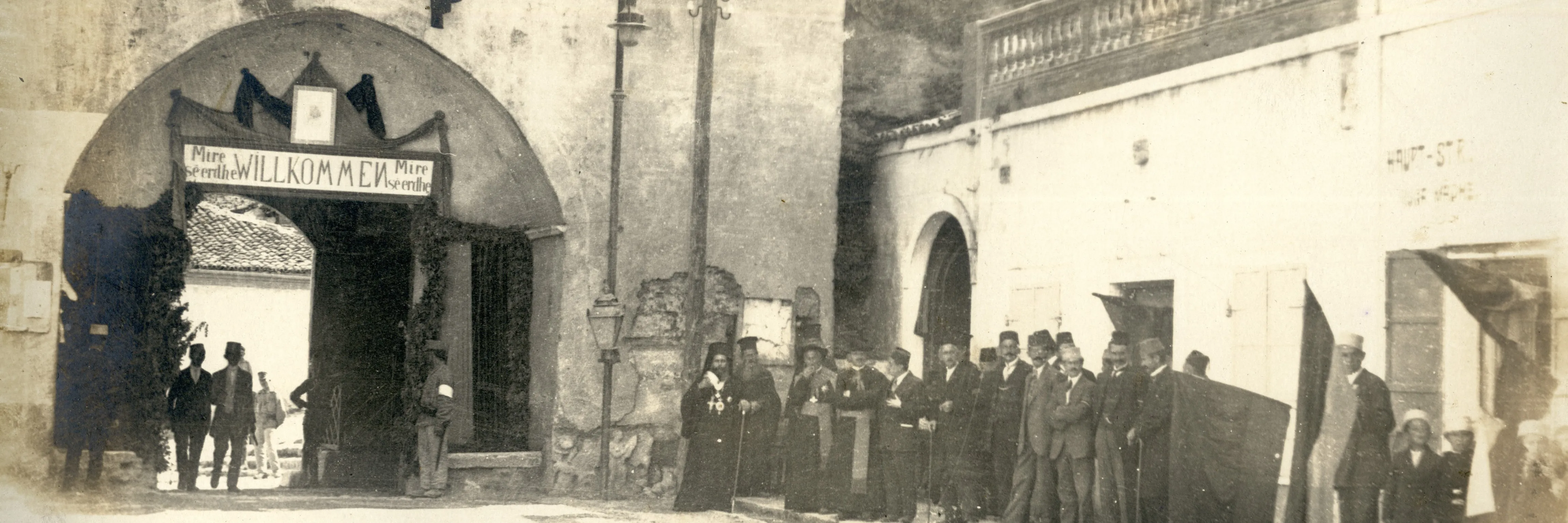
In his paper, Krisztián Csaplár-Degovics spoke about that at the London Conference of Ambassadors (1912–1913), following a joint decision by the great powers, independent Albania was established on humanitarian grounds. The borders and independence of the first Muslim-majority successor state to the Ottoman Empire were jointly guaranteed by the great powers, which also participated jointly in the organization of the new state. The supervision of state building, i.e. the supervision of the development of public administration, the organization of the country’s finances, and the drafting of a new constitution became the task of the International Commission of Control in Albania, whose members were delegated by the Albanian government alongside the great powers.
The commission began its work on site in October 1913. Since, for various reasons, this commission also performed governmental functions for several months, it was particularly interesting to examine its relationship with the local Albanian elite. Contrary to the conclusions of international literature, the local Albanian elite was not entirely incapable of state-building, as it was able to establish local, i.e. municipal and regional, self-governing organizations even under wartime conditions, which, although not very effective, were able to function. In addition, in the spring of 1913, these regional governments were also able to organize themselves into a hierarchy under the loose authority of the Provisional Government in Vlora. The aim of the paper was to demonstrate the local Albanian elite’s ability to organize local governments and their attitude towards the activities of the International Commission of Control.
László Márkusz’s paper summarized the history of Serbian nationalism over the past two centuries. In the history of Serbian nationalism in the last two centuries, depending on the dominant political goal, one can distinguish four major eras: 1. Secession – independence from the Ottoman Empire (1804-1878), 2. Expansion - expanding the borders of the Serbian monarchy (1878-1918), 3. Assimilation - attempt to merge cultures in the Yugoslav context (1918-1981), 4. Irredenta - Serbian revisionism as a reaction to Yugoslav disintegration (1981-). Following the breakup of Yugoslavia, state borders emerged again between Serbia proper and large ethnic Serb-populated areas.
Ernest Gellner’s definition describes nationalism as a political principle that stands for the perfect overlap of political and national unity. The violation of this sacred principle of nationalist sentiment, or in other words, the ethnic territorial loss between 1991 and 2008, explains the anger and frustration Serbian politics displayed in the last decades. Understanding this background of the Serbian elite's attitude towards international state-building efforts in Kosovo and Bosnia-Herzegovina is crucial.
International state-building aimed to create functional democratic countries with strong institutions that exercise effective control over the entire territory of the state. These state-building efforts have often conflicted with the strategic goals of Serbian nationalism, which aims to maintain some level of control over areas in neighbouring countries that ethnic Serbs populate. Even the political term "Serbian World" (Srpski svet) emerged in 2020 as a concept for the political unification of the Serbian nation across borders. The Serbian elite opposes the centralization of Bosnia and Herzegovina (BiH) and Kosovo, while also attempting to limit their international outreach. The paper illustrated these claims with examples.