
László Márkusz
keywords: humanitarian state-building, liberal humanitarian intervention, Bosnia, state-building vs. nation-building, applied history
Nation-building efforts in the 1990s and early 2000s were the products of the post-Cold War global settlement, which relied on US military supremacy. They were based on the dominant faith that liberal values, free elections, democratic institutions, and a market economy could address most of the world's problems. The dominant idea was that adopting liberal values would provide a cure to all sorts of social challenges, including ethnonationalism.[1]
Although it was a product of a unipolar world, one important lesson is that no statebuilding effort can be successful without some level of international consensus. The withdrawal of Russian support for international statebuilding efforts in Bosnia and Kosovo imposed certain limitations on these initiatives. The absence of an UNSC resolution backing Christian Schmidt's nomination as High Representative weakened his political leverage and left him vulnerable to attacks from internal nationalist forces. From 2015 onwards, the Serbo-Russian diplomatic counter-offensive against the international recognition of Kosovo effectively halted the previously successful process. This rivalry among great powers may hinder and ultimately undermine any future statebuilding efforts.
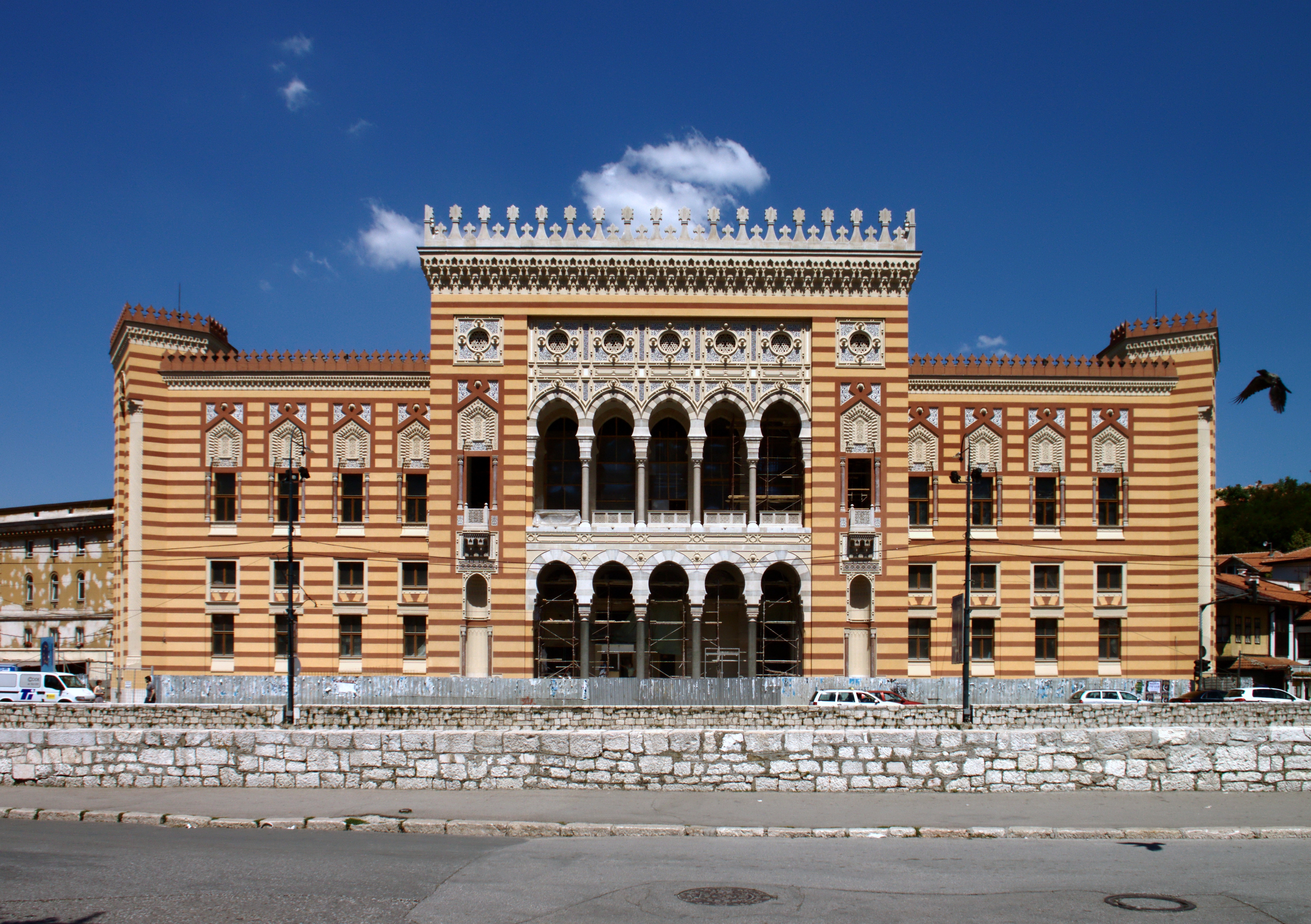
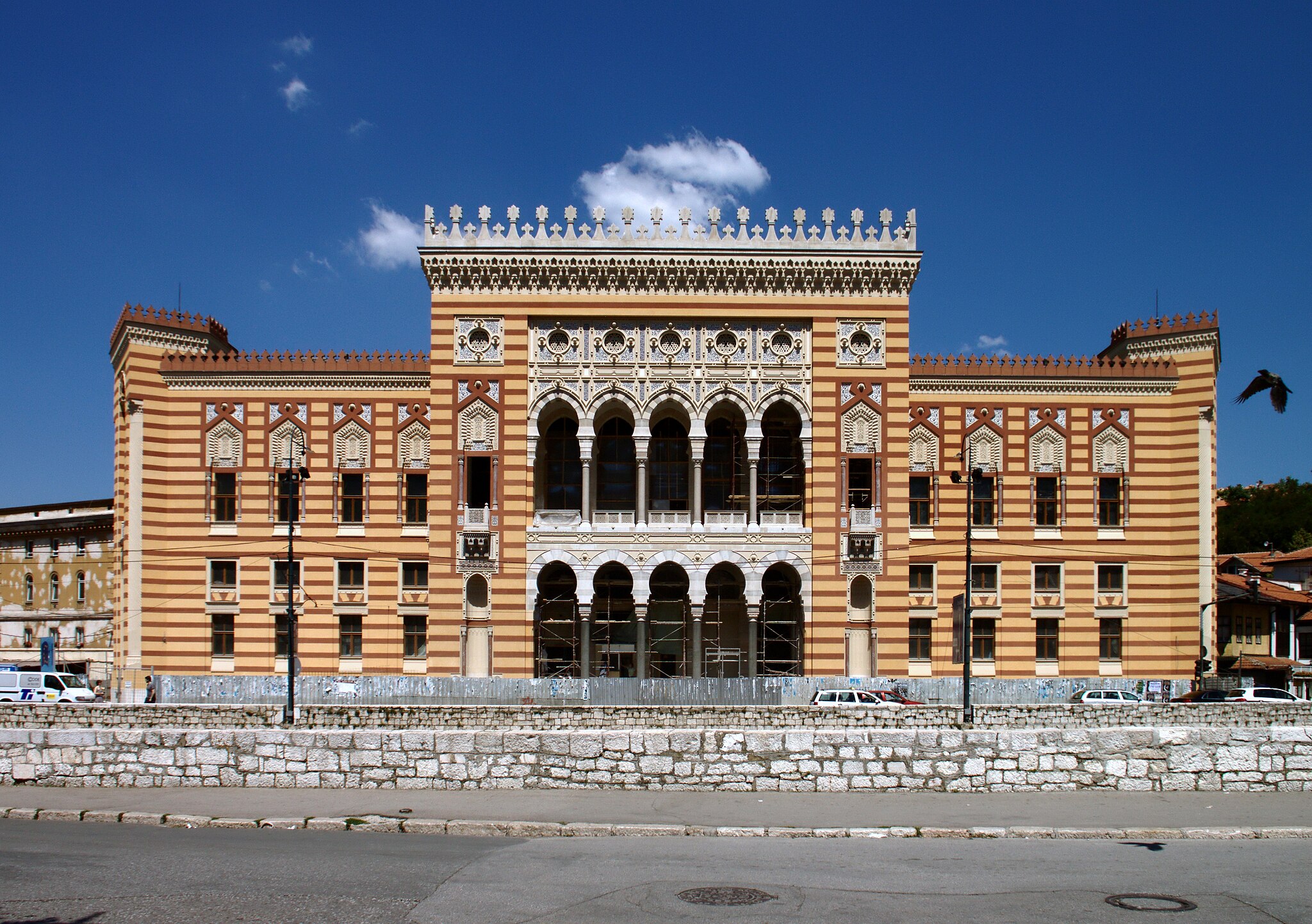 Sarajevo City Hall (Vijećnica), destroyed during the war and then rebuilt in all its glory, is a symbol of the country's cultural rebirth
Photo: Aktron / Wikimedia Commons
Even smaller regional power centers can threaten long-term outcomes. The DPA would not have been implemented without the cooperation of Belgrade and Zagreb. A successful decade for the peace process in BiH followed the departure of Franjo Tudjman and Slobodan Milosevic from the political scene after 2000. Furthermore, without the constructive attitude of the Albanian government in Tirana, efforts toward state-building in Kosovo could have ended in complete failure.
Statebuilding requires the absence of war and political stability. In post-war zones, this political stability can often be provided only by the long-term presence of peacekeepers. KFOR in Kosovo and SFOR in Bosnia prevented new conflicts for years and even decades after their deployment. For this reason, the initial American refusal of long-term military commitment was problematic. The civilian implementation could not even effectively take off in the first two years of the Dayton peace process. It is safe to claim that post-conflict international statebuilding projects can last only as long as there is a strong military element on the ground to provide ‘teeth’ to the civilian staff in case of crisis.[2]
The international community was focusing on “statebuilding” and much less on “nation-building”. In the Anglo-Saxon interpretation, a country's population is by definition a nation. Therefore, if you build a country, you have a nation. However, institution-building is an uphill struggle if those who are meant to operate them disagree on the past and don’t identify common political objectives. The international efforts after Dayton, aiming to secure peace through statebuilding, failed to create a political community, which can be called ‘the Bosnian nation’. The attempt to agree on the past did not succeed, while the only common objective offered by the international community was the ever-deflating promise of EU membership.
The lack of a politically cohesive nation is a significant shortcoming for the long-term stability of a country in Eastern Europe. But was nation-building, as an academician posed the question, ‘a fantasy’, a ‘hopelessly naive idea’?[3] Or was it, as former High Representative Paddy Ashdown put it, a ‘misnomer’? He argued that ‘we can’t build nations, in the sense that the international community can’t impose the emotional ties and patriotism that nationhood implies: those develop naturally or not at all’.[4] It is safe to say that forming a politically cohesive community out of the warring parties after 1995 was not a feasible task within a decade, and any such endeavour would definitely require a different, a more long-term approach to nation-building.
Nation-building in BiH after Dayton did not fail, after all. The country has been at peace for 30 years, offering an environment for an entire new generation since Dayton to grow up, study, work, and form a family. However, the project reached its limitations. because reconciliation was not achieved entirely. The question arises whether it is realistic to attempt ethnic reconciliation only within one generation after a gruesome war? It took 60-70 years after World War II for Serbs and Hungarians in Vojvodina to reach a consensus on the bloody past in World War Two. Also, reconciliation requires political elites who see their interests in the process. Current political elites prefer a weak state with ‘a mid-range democracy’ as a fig leaf towards the West. Limited rule of law and a public sector-heavy market economy offer an easier alternative for those who exercise power than a true liberal democracy and a free market, where a merit-based culture selects the fittest day by day.
László Márkusz
[1] John Gray, The New Leviathans: Thoughts After Liberalism. Farrar: Straus and Giroux, 2023. 47
[2] This point was emphasized by former High Representative Paddy Ashdown as early as June 2003 in the wake of the state-building in Iraq. ‘Broken communities, shattered lives: winning the savage war of peace’ Speech by the Rt. Hon. Paddy Ashdown, High Representative in Bosnia and Herzegovina, to the International Rescue, Committee 06/20/2003 London https://www.ohr.int/speech-by-the-rt-hon-paddy-ashdown-high-representative-in-bosnia-and-herzegovina-to-the-international-rescue-committee/
On the importance of the presence of the military in the early stage of statebuilding see the memoirs of the first High Representative in BiH. Bildt, Carl: Peace journey: the struggle for peace in Bosnia. London: Weidenfeld and Nicolson, 1998. 299–308.
[3] Bose, Sumantra: The Bosnian State a Decade after Dayton. In Chandler, David (ed.): Peace without Politics? Ten Years of International State-Building in Bosnia. London: Routledge, 2006. 22.
[4] Ashdown, Paddy: ‘Broken communities, shattered lives: winning the savage war of peace.’ Speech. London, 2003, június 20. https://www.ohr.int/speech-by-the-rt-hon-paddy-ashdown-high-representative-in-bosnia-and-herzegovina-to-the-international-rescue-committee/